


Pick'Em
How to beat Dabble Pick'Em?
Discover the math behind Dabble Pick’Em and learn how to beat it. This blog explains required win rates, true odds, and variance management.

How does Pick Em make money?
Let's first understand the Maths.
Because Dabble Pick Em offers fixed payouts for each bet type, we can actually work out what win rate you need on your player prop selections to be profitable. In other words, knowing the multiplier helps you determine the minimum accuracy required for your picks to overcome the bookmaker’s edge.
Let’s look at the 3-leg option which offers a 6.5x payout. Since every leg must hit for you to collect the payout, the overall probability of winning the bet is the product of the individual probabilities for each leg. Let’s call the probability of a single pick winning p. Then the probability of winning all three legs is:
Overall Win Probability= p^3
For your bet to be break-even, the expected value (EV) must equal your original stake. With a payout multiplier of 6.5x, the break-even condition is:
p3×6.5=1
p = 0.5356 → 53.56%
This means that, on average, you need to win 53.56% of your individual player prop bets to break even on a 3-leg All-In wager.
Ultimately Dabble believes that most punters cannot do this. And they are right. Most punters would be lucky to achieve a 50% record let along 53.56%. In fact, the average punter would probably be around 40-45%
So how do you win?
It’s actually quite simple. You just need to find bets that have a higher win probability than 53.5%. Although they are offering props, the line is never really a 50/50 pick. Often there are bets where one side of the line is a much bigger favourite than the other. We just need to find bets where the true probability of the event occurring is greater than 53.56%.
One of the best ways to calculate the true probability of an event is to calculate the market average price and remove the market juice in order to get a representation of the market probability of the event occurring.
To better understand why this gives a true representation of an event occurring, check out our blog on Positive EV betting where we cover this topic in depth
Let’s take a look at an example. For easier interpretation, let’s convert the 53.56% into odds. 53.56% is the same as 1/0.5356 = 1.867 odds. In order to find a “value” bet, we need to identify bets where the true odds of the event occurring are below 1.867. So essentially, you can think of every leg in a 3-leg pick-em to be priced at 1.867.
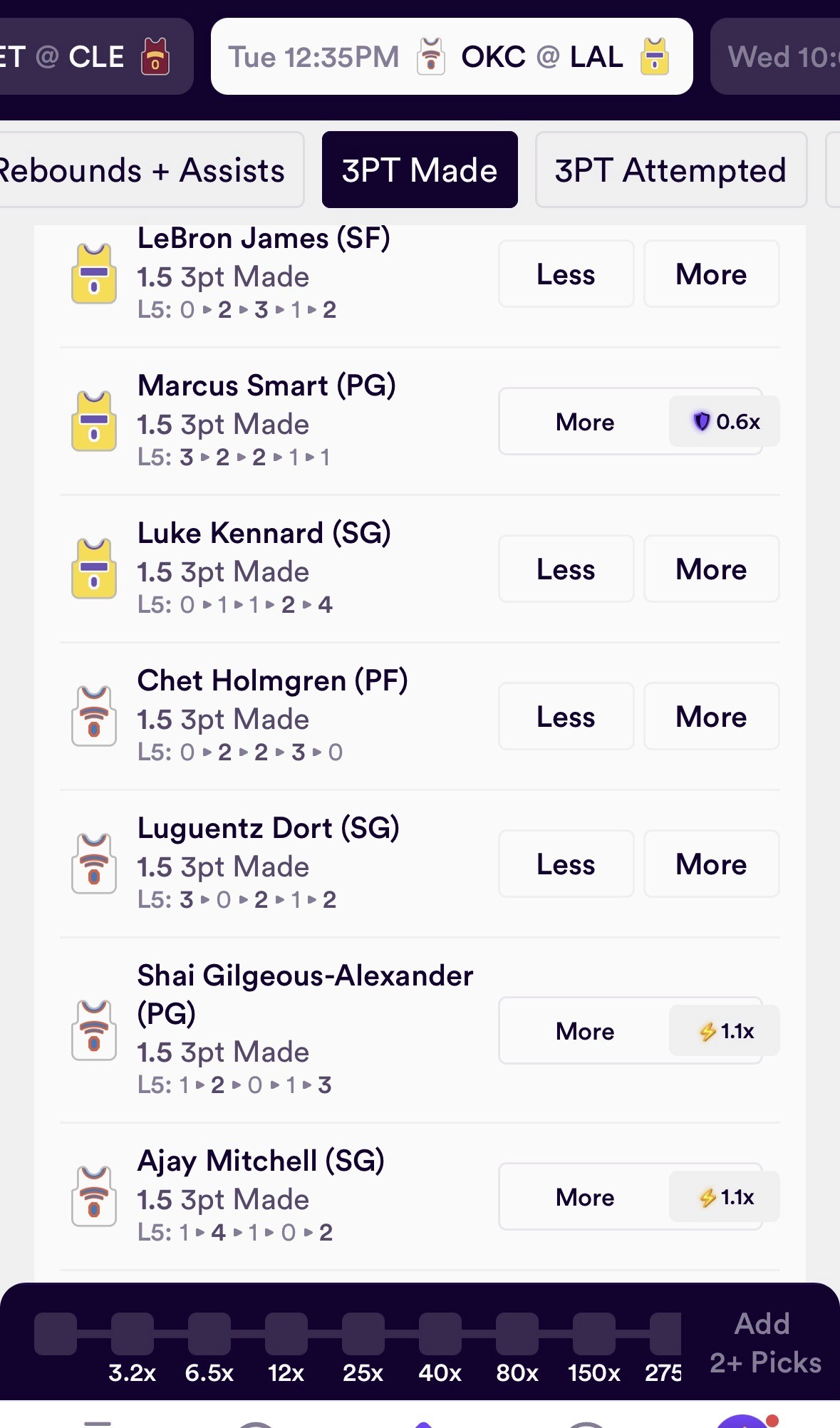
The Pick’Em dashboard will just show you a bunch of lines. You then need to determine the fair odds price and try and find one under 1.867.

Right now we can see that under 1.5 threes for Holmgren is heavily favoured. The market average with vig is 1.61 and when we remove the vig it is 1.71. That is still a lot lower than 1.8671 and represents about 9.0% of value.
The Pick'Em EV tool will show you all the bets whose true value is less than the threshold odds required to beat the Pick'Em.
Different size Pick'Ems have different payouts
Because the payout changes for each number of legs included, the threshold of odds to beat actually changes. Below we go through the payout for each Pick’Em and show the odds to beat:
Legs | Dabble Payout | Threshold Odds | % of bets need to win |
|---|---|---|---|
2 | 3.2x | 1.789 | 55.90% |
3 | 6.5x | 1.867 | 53.56% |
4 | 12x | 1.861 | 53.73% |
5 | 25x | 1.903 | 52.55% |
6 | 40x | 1.849 | 54.08% |
7 | 80x | 1.870 | 53.48% |
8 | 150x | 1.870 | 53.48% |
9 | 275x | 1.867 | 53.56% |
10 | 500x | 1.862 | 53.71% |
11 | 1000x | 1.874 | 53.36% |
12 | 1500x | 1.839 | 54.38% |
Although the differences seem small, they are actually quite significant.
You would almost never play a 2-leg Pick'Em. It would be rare to find odds less than 1.789. The 3.2x payout does not justify the reward. You would be better off combining those legs into a 3-leg Pick'Em to get extra EV.
You can also see that a 5-leg Pick'Em is the most generous. You only need to find legs that are profitable 52.55% of the time. This is by far the best value Pick'Em.
In our opinion, the four-leg Pick'Em almost serves no purpose. You are almost always better off adding an extra leg and getting the added EV from the 5-leg Pick'Em. This strategy has more variance but in the long-run will be more profitable.
As you get passed the 5-leg option, the variance of the Pick"Ems becomes very high. Each leg is still profitable to add but you are taking on a lot more variance.
Calculating EV with Dabble Pick'Ems
Let's calculate the EV for this Pick'Em
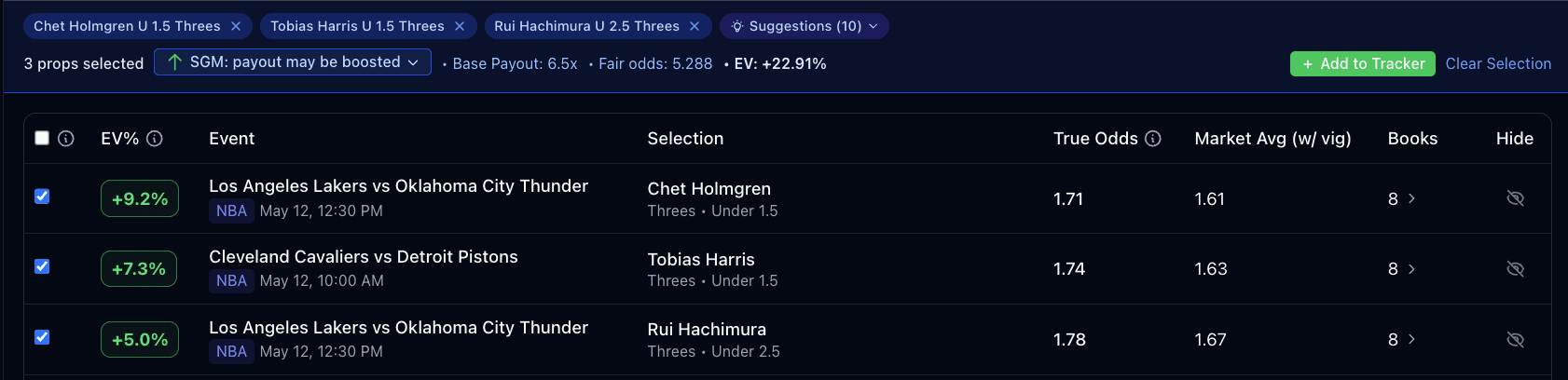
If it is a 2-leg Pick'Em:
Chet Holmgren Under 1.5 threes
Tobias HArris Under 1.5 Threes
Payout = 3.2x
Fair odds = 1.61*1.63 = 2.97
EV = 7.55%
This does not mean we will win this bet every time. But over enough attempts, we can expect that our payout from this bet will be 7.55% Not bad.
But what happens if we add a third leg?
Chet Holmgren Under 1.5 threes
Tobias HArris Under 1.5 Threes
Rui Hachimura Under 2.5 Threes
Payout = 6.5x
Fair odds = 1.61*1.63*1.67 = 5.29
EV = 23.5%
We have tripled our EV and doubled our variance. But this is a much better bet to take now.
Understanding variance
You can keep on adding legs to the Dabble Pick’Em and keep on increasing your EV. However, each leg you add increases the variance. This does not mean the bet is not positive excepted value anymore. But it means you need to play way more volume in order to see those returns.
For instance, you could play a 10-leg Dabble EV netting you a 500x payout and have an EV of 125% (which sounds amazing). But you could play a 10-leg Dabble Pick’Em every day for the NBA season and never win one bet because the variance of this bet is so high.
Like any EV betting, you need patience and volume. The more legs you include in a Pick’Em, the more volume you will need to play until you see profit.
Volume in this context means the number of different Pick’Em plays you bet
Let’s take a deeper look at the 5-leg Pick’Em and map out the probability distribution with the following conditions:
Number of Pick’Ems played = 20
Pick’Em payout = 25x
Fair odds = 20x (this is a 25% EV edge)
Stake = 1 unit
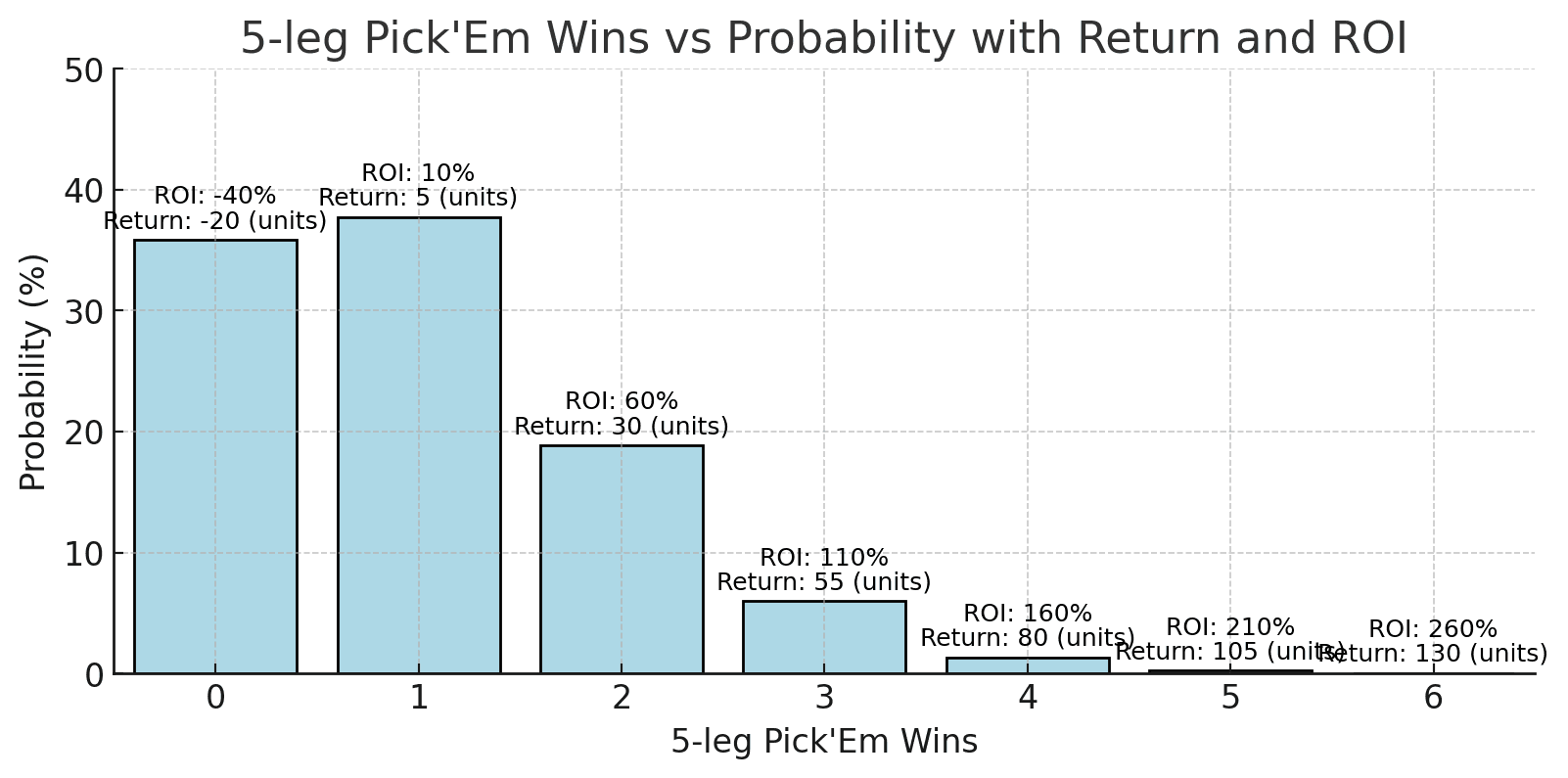
At only 20 attempts, there is a ~35% chance we won’t win a single Pick’Em and we will have a negative return. At 20 attempts, this could very likely happen. When we play Pick’Ems with higher payouts, you need to play a higher volume to ensure you have the expected value on your side. Let’s try look at this again:
Number of Pick’Ems played = 50
Pick’Em payout = 25x
Fair odds = 20x (this is a 25% EV edge)
Stake = 1 unit
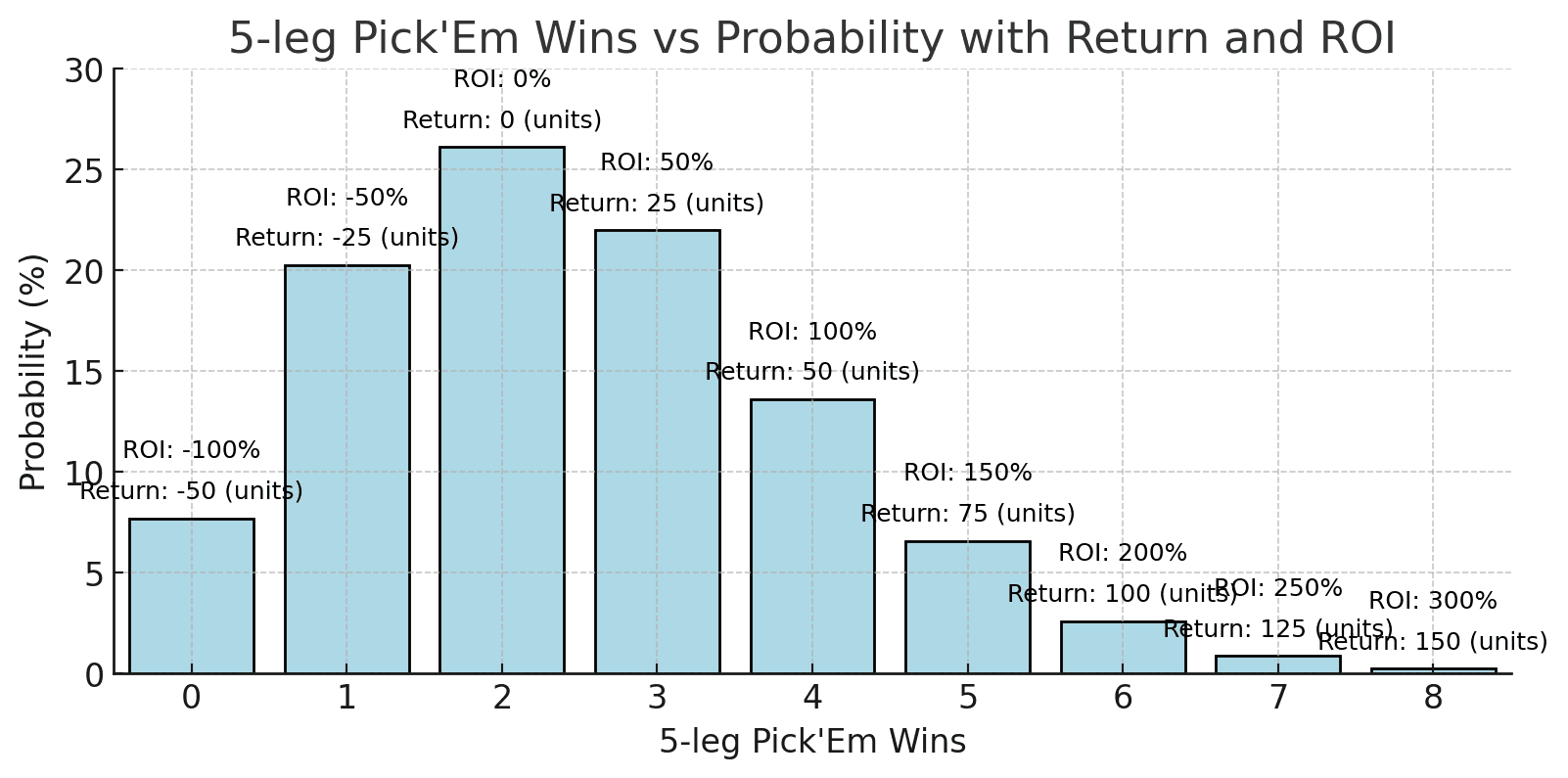
At 50 attempts, we can start to see the probability shifting to the right. There is still a ~28% chance we might have a negative return after 50 bets. However, there is also a lot more probability of winning, and winning big as we look to the far end of the graph.
Before you jump into playing Pick’Ems, especially at the high payouts, you need to understand variance and how that impacts your experience.
How to use the Betsniper Pick’Em EV tool
Our Pick’Em tool makes it super easy to make profitable pick’em bets. The tool calculates all the fair market prices without the market vig for every market that is displayed in the Dabble pick em tool.
It will only show you bets that are below the threshold that you have included in the tool. You can adjust the threshold based on which Pick’Em you are playing.
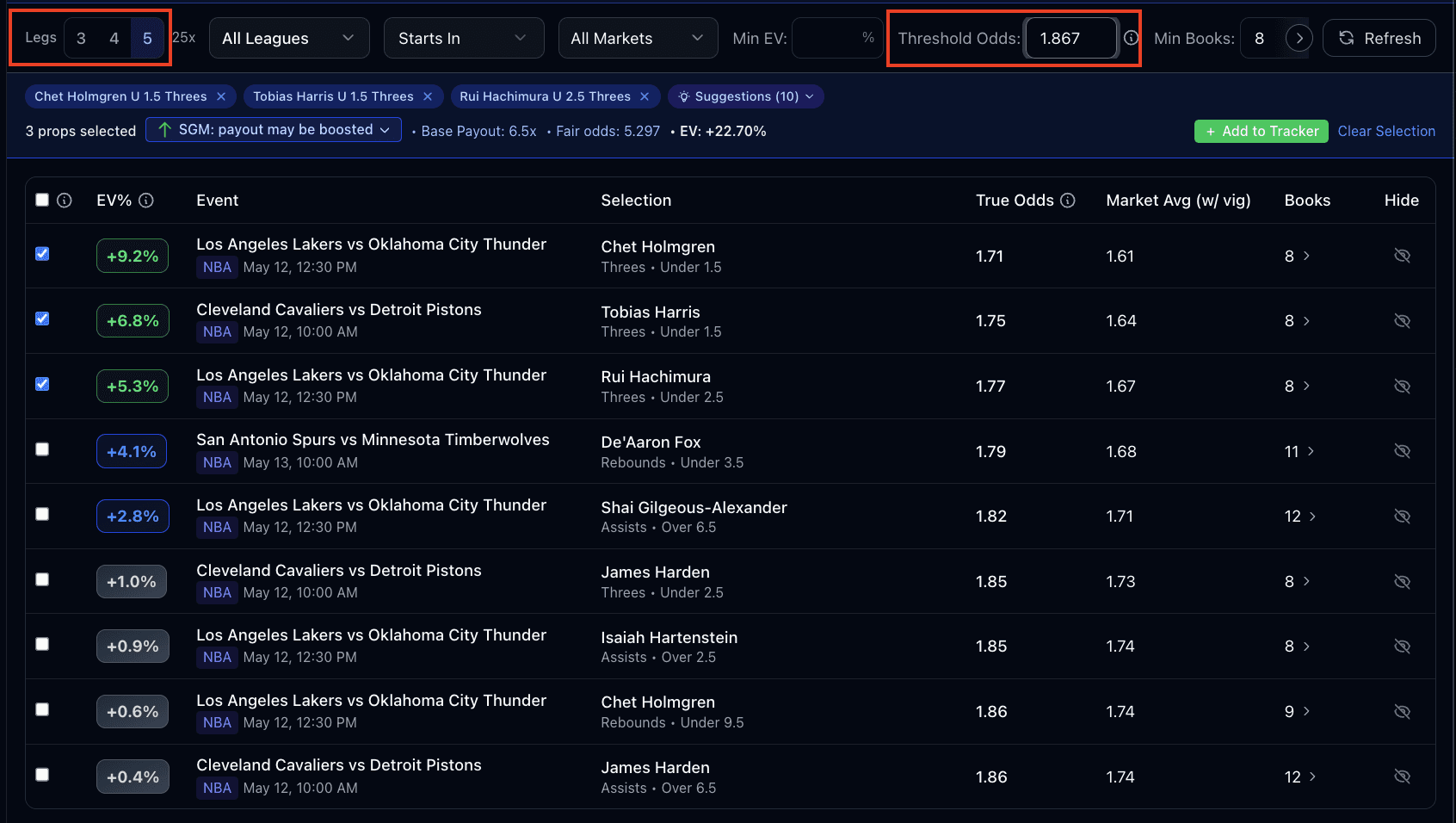
You can either type in the threshold odds. Or if you want a qikcer way you can just select the number of legs in the top left hand corner.
The EV% in the table is determined based off the odds threshold you have included in the filter.
It’s really that simple:
Filter the table by the apprioporate odds
Select your picks
Place the bet
If you do this enough time, consistently, while managing your bankroll, you will be a winner!
Pick'Em is one of the biggest edges you can get in sports betting in Australia today. Check out one of our customers story of going from $100 to $10,000 in 2 months with Pick'Em
By default we calculate the true odds using all books in the market. But there is also an option to only include books you wan tto use as a reference. For example if you only want ot use sharp books like Pinancle and Circa, you can construct your own fair price with these references.
Our recommended best practices
Minimum books: the more the books the better
To feel confident that the price is accurate, it’s recommended that there are at least six books pricing the market. Having multiple books ensures that you can compare odds and get a true representation of the market price. However, if there is not six, you can still feel pretty confident if less books especially if they all have the market priced around the same mark
Bet same day of the game
Placing bets closer to the game time is often your best strategy for two reasons:
Account Safety: If you place bets too far in advance, bookmakers may consider your activity sharp. This could potentially trigger account restrictions or other limitations. Betting closer to game time reduces the risk of drawing attention to your account.
Odds Movement: Especially in sports like basketball, player availability can change drastically as the game day approaches. Odds tend to move significantly based on players being named in or out, or last-minute team changes. Odds you see a day before might no longer be representative of the true value once the game is closer. By waiting until game day, you can ensure you are betting at the best odds available when they are most reflective of the actual game conditions.
Start with smaller Pick’Ems
While it can be tempting to go for higher payout Pick’Ems (like 5-leg or more), the variance associated with these bets can be hard to stomach. The higher the number of legs, the higher the risk, as each additional leg compounds the uncertainty of the bet. It’s better to start with smaller 2-leg or 3-leg Pick’Ems, where the variance is lower and the expected value can still be quite high. As you become more comfortable with the process and understand the variance involved, you can begin to experiment with 4-leg and 5-leg Pick’Ems. But for beginners, it’s advisable to focus on the 2-leg and 3-leg options first.




Learn how to become a profitable punter with our guide
We have put 20+ years of betting knowledge into one guide to help you become a better punter as well as share why each Betsniper tool exists, how to use it and the best strategies you can implement today with the Betsiper tools!

Co-founder
I've been betting seriously for over a decade, ever since I realised you can actually make money from sports betting. I studied Economics and Finance at the University of Melbourne and funded my entire time there through betting. Over the years I've become obsessed with building tools and taking a mathematical, strategic approach to the markets. I've poured that experience into building Betsniper - the ultimate companion tool for the smart punter. I now spend my time educating others on how to think about betting strategically, discovering new strategies and ultimately making as much money as possible from sports betting.


Get access to cutting-edge technology as well as a helpful community to help you start making smart decisions when you are betting.


